WhatsApp vs Email Cart Recovery: Costs and US Rules (2026)
WhatsApp vs email cart recovery: a WhatsApp reminder costs $0.0859 in France and can't reach US numbers; Shopify's abandoned checkout emails are free.
 Nicolas ProvostMar 31, 2026 · 18 min read
Summarize this article with an AI
 ChatGPT
 Claude
Table of contents (30)
Key takeaways
- Use WhatsApp as the first touch for shoppers who opted in outside the US, and email for everyone else and as the second touch.
- Each WhatsApp cart reminder is billed as a marketing message, $0.0859 in France and $0.0635 in the UK on Meta's rate card effective October 1, 2026, while Shopify's abandoned checkout emails are always free.
- Meta does not deliver marketing templates, cart reminders included, to US (+1) numbers, so US carts are recovered by email, SMS or RCS.
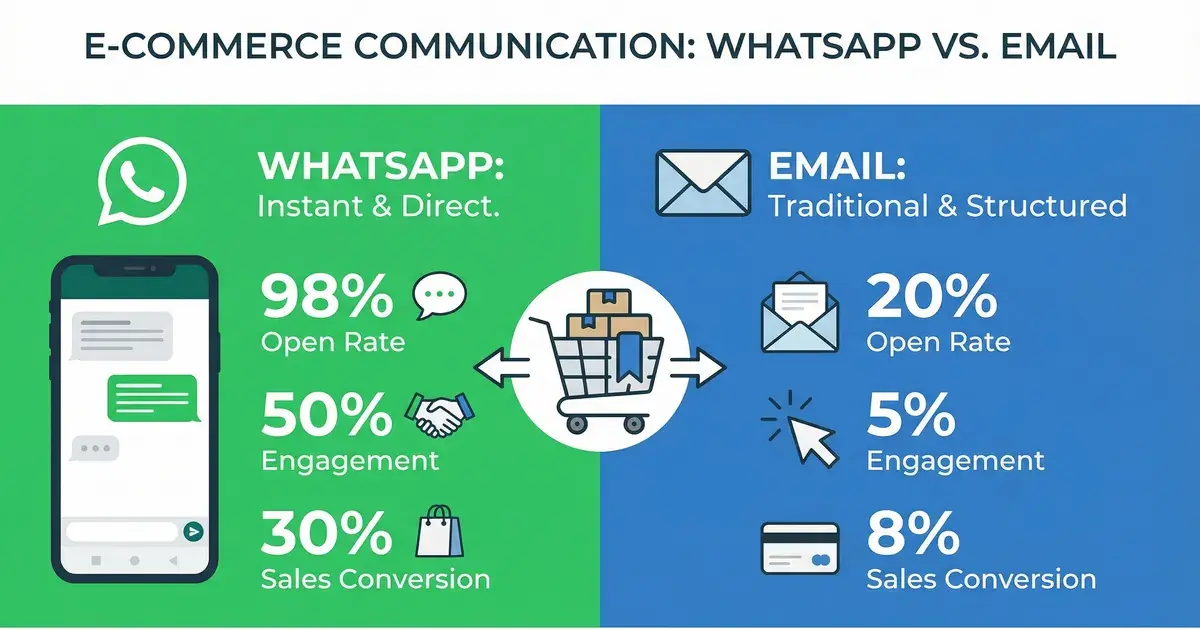
- No independent public benchmark compares the two channels: measure each one on your own store against a holdout group.
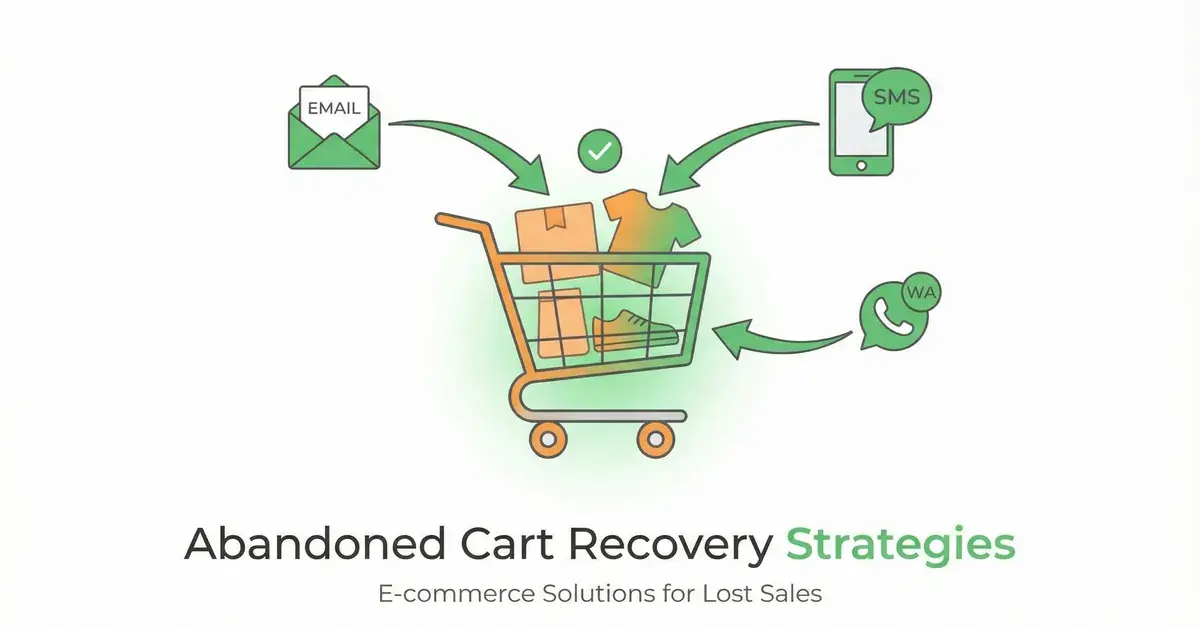
WhatsApp or email for abandoned carts? Use WhatsApp as the first reminder for shoppers who opted in outside the US, and email for everyone else and as the second touch. A WhatsApp reminder costs $0.0859 in France and $0.0635 in the UK as a marketing message on Meta's rate card effective October 1, 2026, and Meta does not deliver it to US phone numbers. Shopify's own abandoned checkout emails are always free, according to Shopify's help center as of November 4, 2026.
Introduction: The Abandoned Cart Problem
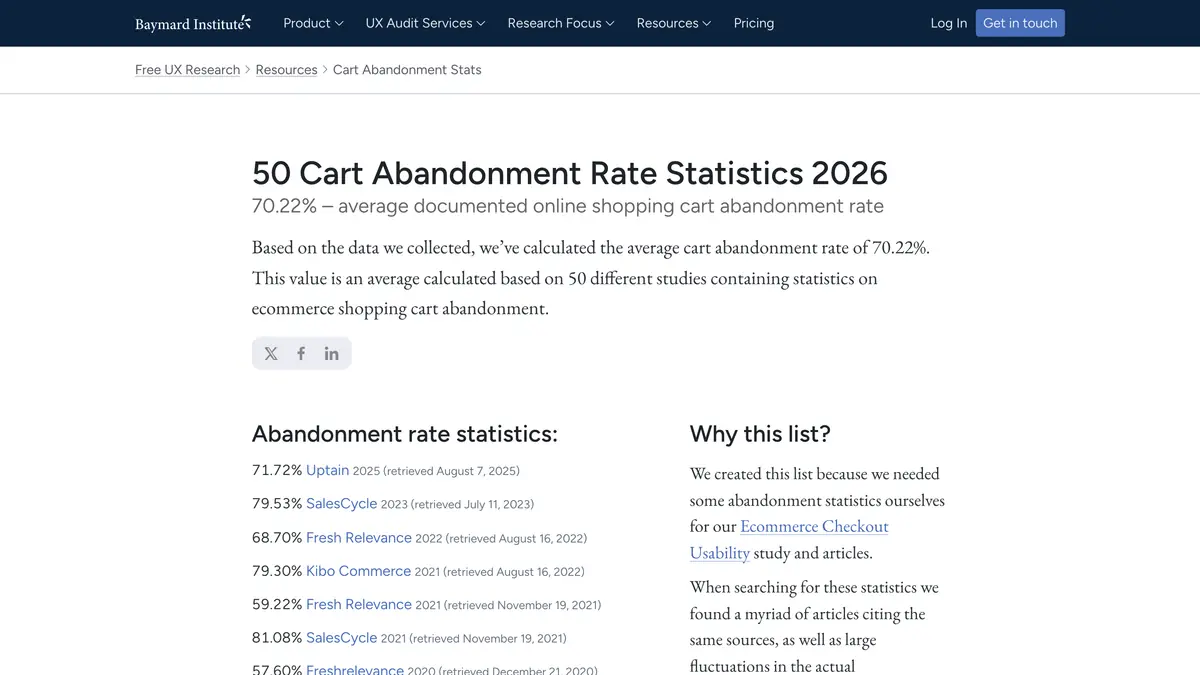
Online shoppers abandon 70.22% of their carts on average, according to the Baymard Institute, which averages 50 studies (page last updated September 22, 2025, read on November 4, 2026). Count the abandoned checkouts in your own Shopify admin and multiply them by your average order value to see how much revenue slips away every month.
The good news: a well-designed abandoned cart recovery flow can bring part of those sales back. The bad news: a store that relies on a single channel misses every shopper that channel does not reach in time.
The channel you use to reach abandoners matters as much as the message itself. A good offer is worth little if it sits in a Promotions tab, or if it is a WhatsApp template that Meta never delivers.
This guide compares the two cart recovery channels most Shopify stores weigh, WhatsApp and email: their strengths, their costs on November 4, 2026, the US rule that changes the answer, how to measure them, and a sequence that combines both. If you are new to the channel, start with our guide to WhatsApp marketing for e-commerce.
WhatsApp for Cart Recovery
WhatsApp puts your reminder in the app where customers already chat with friends and family. Here is where it works for cart recovery, and where it falls short.
Pros of WhatsApp Cart Recovery
Messages land in a chat app. A WhatsApp reminder arrives as a notification next to messages from friends and family. There is no Promotions tab and no spam folder. Meta does limit how many marketing messages each person receives from businesses: its per-user marketing limits page says the limit depends on the person's recent read rate and inbox activity, which is one more reason to message only shoppers who opted in.
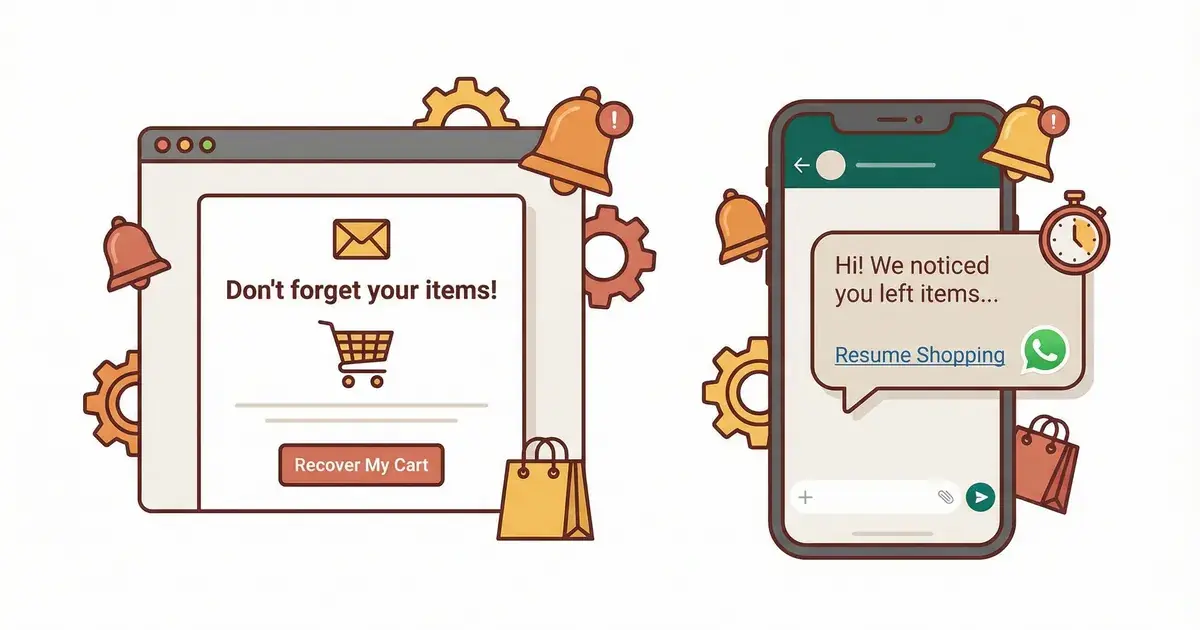
Two-way conversation. A shopper who gets your reminder can reply in the same chat: "Does this come in blue?" "What's the shipping cost to Berlin?" Answering on the spot removes the objection that stopped the purchase, and a WhatsApp AI agent can take those replies when your team is offline. After a recovery email, the same shopper has to find your support address, write a message and wait.
Images and buttons. A WhatsApp template can carry a product image and a button that links back to the cart, so the return to checkout takes one tap. Ready-made wording for each step is in our WhatsApp abandoned cart templates.
Speed. A reminder works best while intent is fresh. A WhatsApp notification reaches the phone right away, so a message sent in the first hour can land while the shopper still has the product in mind.
Cons of WhatsApp Cart Recovery
Opt-in is mandatory. WhatsApp's Business Policy requires a customer's permission before you message them. Your WhatsApp audience is limited to shoppers who opted in, while you already hold the email address of everyone who reached checkout. Our WhatsApp opt-in guide covers how to collect it under GDPR.
No delivery to US numbers. Meta's template categorization guide gives a cart reminder ("You left items in your cart") as an example of a marketing message, and Meta's per-user limits page states that WhatsApp does not currently deliver marketing template messages to US phone numbers (a +1 dialing code and a US area code). For a store selling in the US, WhatsApp cart recovery only covers the non-US part of the audience. Our guide to WhatsApp marketing in the USA explains what still delivers.
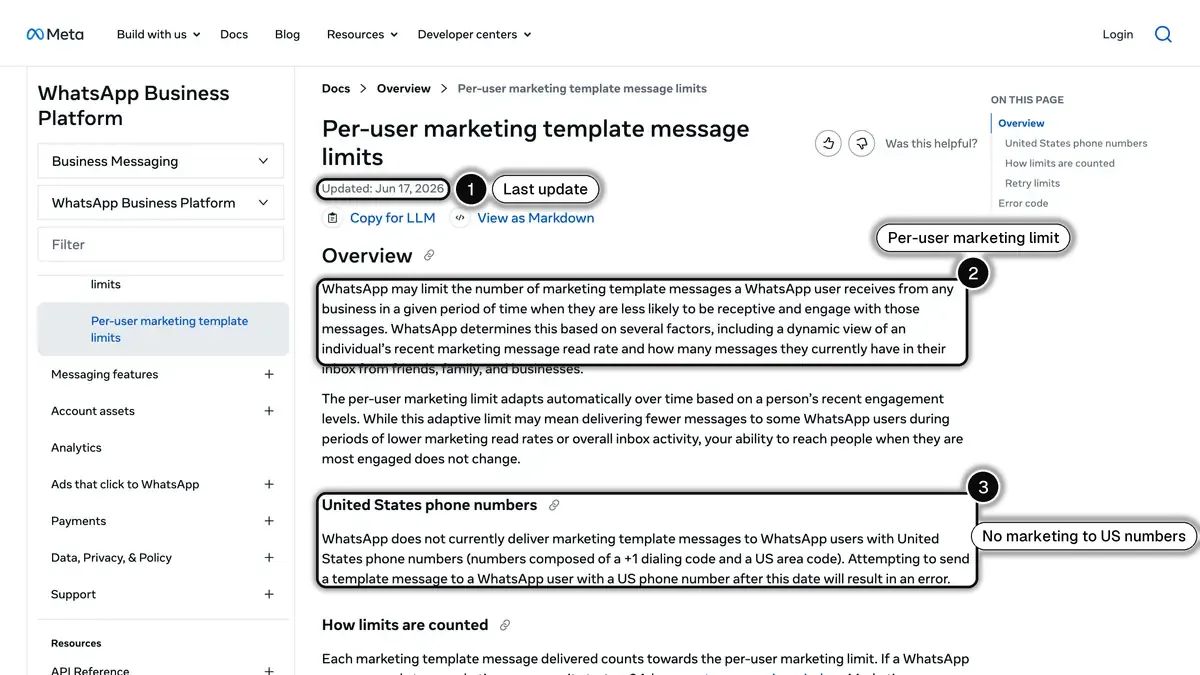 Source: Meta for Developers, per-user marketing template message limits, read on October 24, 2026. In 1, the date of the last update; in 2, the per-user limit that applies in every country; in 3, the rule for US phone numbers.
Every reminder is billed. Meta charges each delivered cart reminder as a marketing message: $0.0859 in France and $0.0635 in the UK on its rate card effective October 1, 2026. Meta can change rates only on the first day of a quarter, according to the pricing calendar in its documentation, so the next possible change is January 1, 2027. A three-step sequence costs three marketing messages per shopper who receives all three. Rates for other countries are in our WhatsApp Business pricing guide.
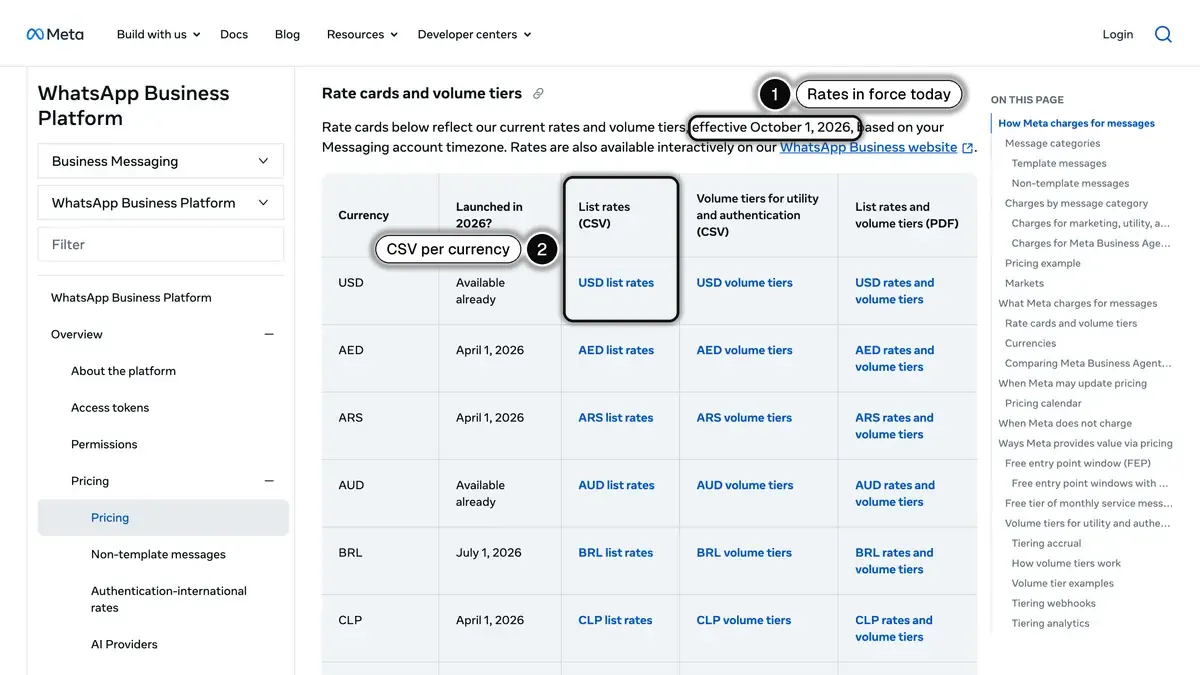 Source: Meta for Developers, pricing documentation. In 1, the rate cards in force since October 1, 2026; in 2, the CSV list rates per currency.
Reach varies by country. WhatsApp is the everyday messaging app in some countries and a minor one in others. Look at how many of your customers opt in before you plan around it.
Email for Cart Recovery
Email has been the default recovery channel for over a decade. It reaches the most shoppers at the lowest cost, but it has limits that matter when every hour counts.
Pros of Email Cart Recovery
Universal reach. Every shopper who typed an email address at checkout can receive an abandoned checkout email. That makes email the channel with the largest recoverable audience, and the only one of the two that reaches US shoppers today.
Low or zero cost. On Shopify Messaging, abandoned checkout emails are always free and do not count towards the monthly limit, and other emails cost $1 per 1,000 beyond the 10,000 free each month (up to 300,000 emails) on the Basic, Grow, Advanced and Plus plans (Shopify's help center, as of November 4, 2026). Klaviyo's free plan covers up to 250 profiles and 500 emails a month, according to Klaviyo's pricing page on the same day; our Klaviyo pricing guide covers its paid tiers.
Design flexibility. Email supports full HTML layouts, product grids and your brand's fonts and colors. For brands that rely on visual storytelling, it offers more room than a WhatsApp template.
Mature automation. Tools like Klaviyo, Mailchimp and Omnisend have spent years on email flows: delays, A/B tests, dynamic product blocks and conditional splits. Our comparison of email marketing apps for Shopify covers the main ones.
Cons of Email Cart Recovery
Crowded inboxes. Gmail's Promotions tab, spam filters and sheer volume mean a recovery email has to fight for attention, and a drop in domain reputation can push it into spam.
Delayed engagement. An email can sit unopened for hours. By the time it is read, the first hour after abandonment, when intent is still fresh, has passed.
One-way in practice. Customers rarely reply to a recovery email, and when they do, the reply lands in a support inbox, not in a conversation. Questions that blocked the purchase stay unanswered.
Head-to-Head Comparison
Here is how WhatsApp and email compare on the criteria that matter for cart recovery, as of November 4, 2026:
| Criterion | ||
|---|---|---|
| Cost per message | $0.0859 (France) or $0.0635 (UK) per marketing message, on Meta's rate card effective October 1, 2026 | Shopify's abandoned checkout emails are free; other Shopify Messaging emails cost $1 per 1,000 beyond 10,000 a month (Shopify) |
| Who you can reach | Shoppers who opted in to WhatsApp | Every shopper who entered an email at checkout |
| US (+1) numbers | Cart reminders not delivered (Meta) | Delivered |
| Consent rules | Opt-in required by WhatsApp's Business Policy, plus GDPR in the EU | In the US, CAN-SPAM requires a working opt-out, honored within 10 business days (FTC); GDPR in the EU |
| Format | Short text, product image, buttons | Full HTML design, product grids |
| Filtering | No spam folder; Meta caps marketing messages per person | Promotions tab and spam filters |
| Two-way conversation | Yes, in the same chat | Rarely, through a support inbox |
| Best for | First touch for opted-in shoppers outside the US | Every shopper, US shoppers, second touch |
The takeaway: WhatsApp brings speed, images and a real conversation with the shoppers it can reach. Email wins on cost and on reach, and it is the only one of the two that recovers US carts. Most stores need both, measured on their own data.
Which Channel for Which Cart
The right first touch depends on who left the cart:
| Situation | First touch | Why |
|---|---|---|
| Shopper opted in to WhatsApp, outside the US | Seen fast, one-tap return, can ask a question | |
| Shopper with a US (+1) number | Email, then SMS or RCS with consent | Meta does not deliver WhatsApp marketing templates to US numbers |
| Shopper with no WhatsApp opt-in | Only channel you are allowed to use | |
| High-value cart with likely questions (sizing, delivery, compatibility) | WhatsApp, with a person or an AI agent ready to answer | A reply settles the objection |
| Low-value cart at high volume | The cost per reminder matters more than speed |
Where SMS and RCS fit: SMS reaches any consenting mobile number, US included, and RCS adds images and buttons on the phones that support it. Our guide to abandoned cart text messages for Shopify covers the wording and the US rules, and the SMS and RCS pages show how they sit next to WhatsApp.
Measuring Results: What a Fair Test Looks Like
There is no independent public benchmark comparing cart recovery rates by channel, and vendor figures are not audited. The numbers that decide the question are the ones you measure on your own store:
- Recovery rate per channel: carts recovered after a reminder, divided by carts that received it.
- Revenue per 1,000 abandoned carts: what each flow brings back for every 1,000 carts that enter it.
- Recovery by delay: how many recoveries come after the 1-hour, 24-hour and 72-hour touches.
- Holdout group: a slice of abandoners who get no reminder, so you measure the lift rather than the buyers who would have come back anyway.
- Opt-outs and blocks: unsubscribes on email, blocks and opt-outs on WhatsApp, per step.
Run the test for at least one full sales cycle and change one variable at a time.
The Best Strategy: Omnichannel Recovery
Neither channel reaches every abandoner on its own. The approach we recommend is an orchestrated flow that uses WhatsApp as the first channel for the shoppers it can reach, and email for everyone else.
Here is why this combination works:
- WhatsApp reaches opted-in buyers fast. The 1-hour and 24-hour WhatsApp touches land while purchase motivation is still strong.
- Email catches the rest. Shoppers without a WhatsApp opt-in, US shoppers, and those who did not open the WhatsApp message get a second chance by email.
- No channel fatigue. Alternating between WhatsApp and email, rather than sending both at the same time, respects the shopper's attention and keeps opt-outs down.
The Optimal Timing Sequence
| Timing | Channel | Purpose |
|---|---|---|
| 1 hour | First reminder, while intent is fresh | |
| 4 hours | Reach shoppers not on WhatsApp, and US shoppers | |
| 24 hours | Second touch with reviews or a stock reminder | |
| 48 hours | Product details and brand story | |
| 72 hours | Last reminder, with an incentive if you use one |
Stop every step as soon as the order is placed. Then run this flow against your current email-only sequence, with a holdout group, to measure what the orchestration adds.
What It Costs: a Worked Example
The store is fictional. It sells in France, has 1,000 abandoned checkouts a month, and 300 of those shoppers opted in to WhatsApp.
- WhatsApp: at most 3 reminders × 300 shoppers = 900 marketing messages. 900 × $0.0859 = $77.31 in Meta fees, at France's rate on Meta's rate card effective October 1, 2026. The same volume to UK numbers costs 900 × $0.0635 = $57.15.
- Email: Shopify's abandoned checkout emails are free. With another email tool, the cost is your plan.
- Platform: the monthly plan of the WhatsApp tool you use comes on top.
Shoppers who buy after the first reminder do not receive the next ones, so the real number of WhatsApp messages is lower.
ROI: Run the Numbers for Your Store
Compare the strategies with the same formulas, using your own figures:
- Revenue recovered = abandoned carts that received the reminder × recovery rate × average order value
- Monthly cost = platform subscription + message fees (Meta fees for WhatsApp, your email plan for email)
- ROI = revenue recovered ÷ monthly cost
A channel that costs almost nothing per send, like email, shows a high ROI ratio mechanically. Absolute revenue recovered is what pays the bills, so compare both the ratio and the revenue each strategy brings back. For tactics beyond channel choice, see our abandoned cart recovery strategies guide, and to compare tools, our list of Shopify abandoned cart apps.
Implementation Guide: Setting Up a Combined Flow
Step 1: Map who you can reach
Count last month's abandoned checkouts, then split them three ways: shoppers who opted in to WhatsApp, shoppers with a US (+1) number, and everyone else. The first group is your WhatsApp audience; the other two go to email first.
Step 2: Collect WhatsApp opt-ins
Ask for WhatsApp consent where shoppers already are: a pop-up, a chat button, the order confirmation page. State what they will receive and how to stop. Track your opt-in rate from day one: it sets the ceiling of your WhatsApp recovery.
Step 3: Prepare the templates
A WhatsApp cart reminder is a marketing template that Meta reviews before you can send it. Keep it short: the shopper's name, the product, an image and a button back to the cart. Our WhatsApp Business templates guide shows how categories are assigned.
Step 4: Keep the email flow running
Leave your abandoned checkout emails on for everyone. Shopify's are free; if you use Klaviyo or another tool, keep your existing flow and add the delays from the sequence above.
Step 5: Stop on purchase and avoid double sends
Make sure every step checks that the order has not been placed, and that a shopper does not get the WhatsApp and the email reminder in the same hour.
Step 6: Measure and adjust
Track recovery and revenue per channel and per step against the holdout group. Change one variable at a time: delay, wording or incentive.
Running the WhatsApp Side With Kanal
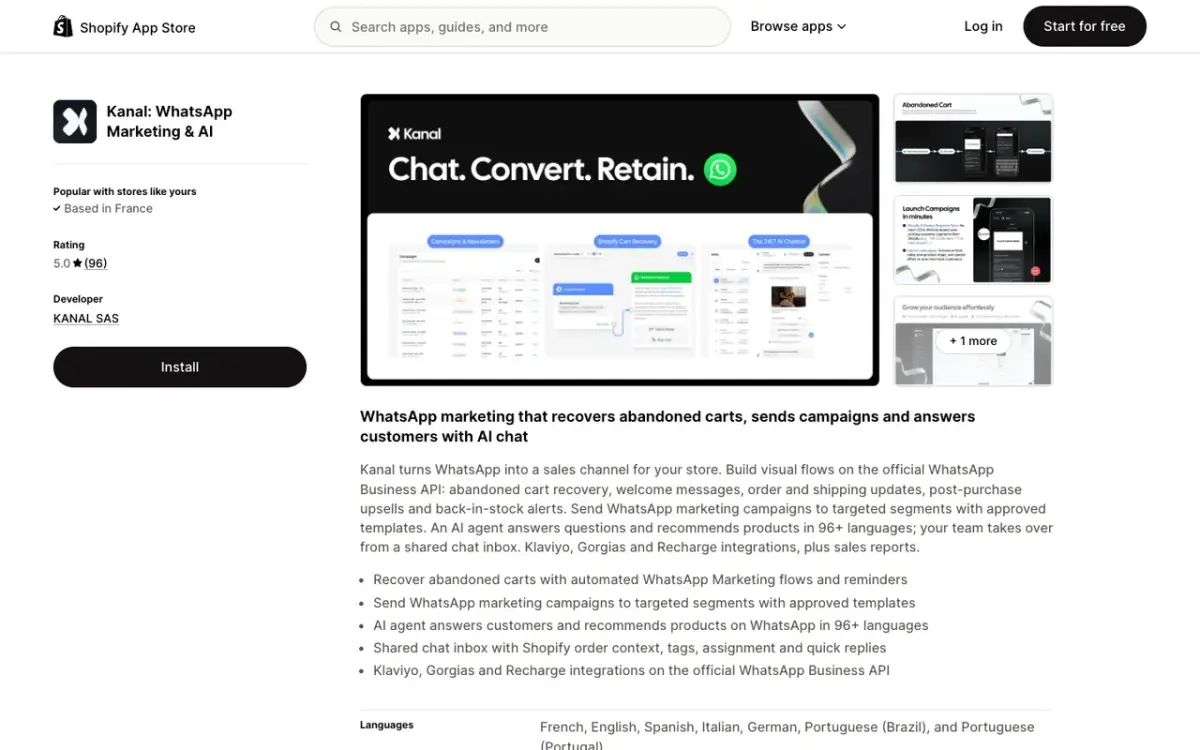
Kanal is a WhatsApp marketing and sales app for Shopify stores, rated 5.0 on the Shopify App Store. For this flow, it runs the WhatsApp side: abandoned cart recovery reminders to opted-in shoppers, a pop-up and a chat widget that open WhatsApp to collect opt-ins, a shared team inbox where shoppers' replies land, and revenue tracked per message, so you can compare the WhatsApp steps with your email flow. On the Scale and Business plans, an AI agent answers shoppers' replies, and RCS and SMS are included from the Scale plan, which gives US carts a route that WhatsApp marketing templates do not.
One published result: Jean Fourche, a premium bike and apparel brand, reports a +42% cart recovery rate, a 96% open rate and a 14X ROI on WhatsApp with Kanal, "outperforming email by 8x", according to our case studies.
Kanal sends no email, so your abandoned checkout emails stay in Shopify or your email tool. It does not sync the Shopify checkout consent box either: WhatsApp opt-ins come from Kanal's pop-up and chat widget. Plans are listed on the pricing page (read on November 4, 2026): Pro at €89 a month, Scale at €149 and Business at €350, with Meta's WhatsApp message fees billed on top. To connect the store, see Kanal's Shopify integration.
Frequently Asked Questions
Is WhatsApp better than email for abandoned cart recovery?
For shoppers who opted in to WhatsApp outside the US, it is the stronger first touch: the reminder lands in a chat app, carries images and a button back to the cart, and the shopper can reply with a question. Email reaches more people, including every US shopper, and Shopify's abandoned checkout emails are free. No independent public benchmark compares the two, so combine them and measure each one against a holdout group.
Is WhatsApp more effective than email for reaching and converting customers?
WhatsApp reaches fewer customers, because it needs an explicit opt-in and Meta does not deliver marketing templates to US numbers. Email reaches every customer who left an address. Which one converts better on your store is a question for your own data: send each reminder to a test group, keep a holdout group that gets nothing, and compare the revenue recovered per channel.
How much does WhatsApp abandoned cart recovery cost?
Meta bills each delivered cart reminder as a marketing message: $0.0859 in France and $0.0635 in the UK on its rate card effective October 1, 2026, and every reminder in the sequence is billed. Add a platform plan: Kanal's plans start at €89 a month, and Meta bills its message fees on top. Divide your total monthly cost by the carts the flow recovers to get your cost per recovered cart.
Do WhatsApp abandoned cart reminders reach US customers?
No. Meta classes a cart reminder as a marketing message, and its documentation states that WhatsApp does not currently deliver marketing template messages to US phone numbers (a +1 dialing code and a US area code). For US shoppers, recover carts by email, and by SMS or RCS with their consent.
Should I use both WhatsApp and email for cart recovery?
Yes. Send WhatsApp first to shoppers who opted in, send email to everyone else, and alternate the two for the second and third touches. Stop the sequence as soon as the order is placed, and compare the combined flow with each channel alone to see what each one adds.
Where do SMS and RCS fit next to WhatsApp and email?
SMS reaches any mobile number that gave consent, including US numbers, and RCS adds images and buttons on phones that support it. They are the usual route for US shoppers and for customers who do not use WhatsApp.
Conclusion
WhatsApp brings what email lacks for abandoned cart recovery: a reminder seen in a chat app, an image with a one-tap return to the cart, and a real conversation. Email brings what WhatsApp lacks: every shopper who reached checkout, US shoppers included, at little or no cost.
The answer is not one or the other. Send WhatsApp first to the shoppers who opted in outside the US, keep email running for everyone, add SMS or RCS where WhatsApp cannot deliver, and measure what each channel adds against a holdout group. To set up the WhatsApp side on Shopify, see WhatsApp abandoned cart recovery.
See Kanal on your own store
- Your campaigns and cart reminders on WhatsApp, starting from your own store
- Post-purchase offers, back-in-stock alerts, then the AI agent that advises your customers
- You leave with the plan that fits and its price
From €89/month
- brands
- 500+
- to set up
- 5 min
- open rate on WhatsApp
- +90%
Nicolas helps e-commerce brands grow revenue with WhatsApp marketing. With deep expertise in Shopify ecosystems and conversational commerce, he shares proven strategies for abandoned cart recovery, broadcast campaigns, and AI-powered customer engagement.